

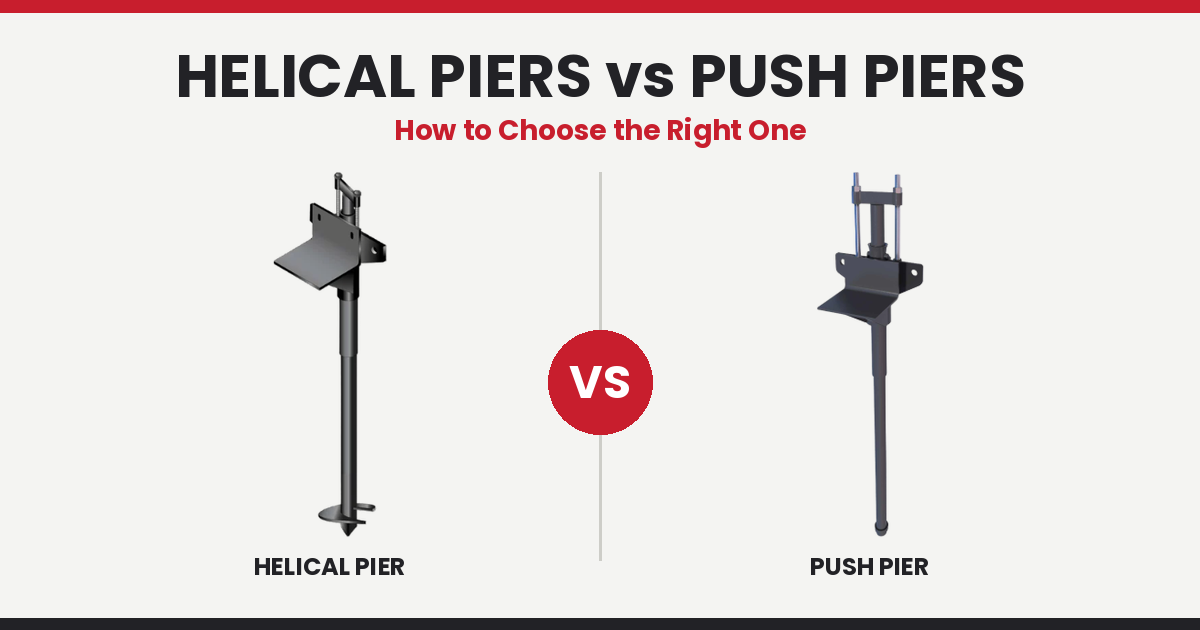
Helical piers vs push piers comes down to three things: soil, structure weight, and pier load. Therefore, a third-party engineer should confirm the right choice for each building. At Straight Line Construction and Ram Jack, we install both. The recommendation follows the engineering, not the equipment on the truck.
What piers do for a settling foundation
Both piers move a building's weight past weak surface soil. Soil near the surface can shrink, swell, or settle. As a result, a slab or footing can sink or tilt.
Steel piers reach deeper, more stable ground and carry the load from there. We use Ram Jack piers. Ram Jack manufactures them in Ada, Oklahoma, with American-made steel.
How helical piers work
A helical pier is a steel shaft with helical-shaped plates, much like a large screw. A hydraulic motor turns it into the ground.
Crews can install helical piers from inside or outside a structure. They need little excavation, so installation is often quick. In addition, helical piers work for light and heavy loads, in repairs and new construction.
How push piers work
A push pier is a hollow steel tube driven into the ground with hydraulic jacks. The building's own weight supplies the resistance. Therefore, the pier advances until it reaches firm soil or bedrock.
Push piers can be cost-effective on heavier structures. They also perform well where bedrock sits shallow.
Helical piers vs push piers: a side-by-side comparison
- Installation: Helical piers screw in with a hydraulic motor. Hydraulic jacks drive push piers in.
- Resistance: Helical plates grip the soil. Push piers rely on the weight of the structure.
- Best fit: Helical piers suit light or heavy structures. Push piers suit heavier buildings.
- Limits: Rocky, cobble, or boulder soils can stop helical piers. Light structures may not give push piers enough weight.
How engineers choose between helical piers vs push piers
This is where our design-build approach shines. We handle everything in house, so one team guides you from the first visit to the final pier. As a result, there are no contractors to juggle.
First, you meet with a foundation repair specialist who inspects your home and answers your questions. Next, you may move forward with a floor level survey. In short, this precise measurement shows where your structure has moved.
Then we work with third-party engineers to build a custom repair plan for your home. Because of this, their independent expertise points to the most accurate solution. Meanwhile, our team takes care of the details, including the paperwork and permits.
Engineers weigh the soil, the structure's weight, and the footing condition. For example, light structures such as garages, sunrooms, or wood-framed homes may not push a pier deep enough. In that case, an engineer may specify helical piers instead.
Commercial projects add heavier loads and tighter schedules. Property managers and contractors can review our commercial helical piles and commercial push piers pages for technical detail. Homeowners can start with our piers and micropiles overview.
Not sure you need piers? Know the signs
Is that crack cosmetic or a real concern? Fortunately, several clues can help you decide. Look for cracks in walls, floors, or slabs. Also watch for doors and windows that stick, or floors that slope.
Any of these signs is a good reason to book an inspection. Our specialists will look at the whole picture, including the soil around your home. Read our guide to signs of foundation damage to learn more.
Your next step on helical piers vs push piers: a free inspection
Here is the bottom line on helical piers vs push piers. The right pier depends on your soil, your structure, and your load. Fortunately, you do not have to figure that out alone. We bring the specialist, the survey, the engineers, and the crew, all under one roof.
Ready for answers? Contact us today for a free inspection and estimate, with no pressure. Our offices serve homeowners and commercial clients in Arizona, Colorado, and New Mexico. In addition, we serve Phoenix, Tucson, Denver, Pueblo, and Albuquerque.
Call (480) 941-3448 for Arizona. Call (303) 716-7437 for Denver and Northern Colorado. For Colorado Springs and Pueblo, call (719) 545-9942. In New Mexico, call (505) 771-8890.
Neither is better in every situation. Helical piers handle more soil and structure types, while push piers suit heavier buildings. An engineer matches the pier to the site.
Neither pier system is universally less expensive. The overall cost depends on several factors, including soil conditions, structural requirements, accessibility, and the number of piers needed.
Push piers are often a cost-effective option for stabilizing existing structures, while helical piers offer versatility in applications where soil conditions, structural loads, or installation requirements make them the better choice.
Ultimately, the most cost-effective solution is the one best suited to the property’s specific conditions. A professional evaluation can help determine which system provides the most reliable and appropriate long-term solution.
Which causes less disruption to your property: helical piers or push piers?
Both helical and push piers are designed to stabilize foundations while minimizing disruption to the surrounding property. The amount of excavation and disturbance depends on the installation location, site conditions, and access requirements. Both systems typically require localized excavation at each installation point, rather than extensive excavation around the entire foundation. The best solution depends on the property’s structural needs and soil conditions.