Higher Lateral Loads Required an Alternative Foundation Design
The construction of a new U.S. Bank branch in San Tan Valley, Arizona required a deep foundation system capable of supporting significant structural loads while resisting elevated lateral forces. During design review, Straight Line Construction determined that a conventional vertical helical pier system would require extended guide sleeves to satisfy the project’s lateral load requirements. Rather than accepting the higher material and installation costs, the team developed an engineered battered helical pier solution that achieved the required performance more efficiently.
This value-engineered approach reduced construction costs while maintaining the required structural capacity. The revised design demonstrated how engineering decisions can improve constructability without compromising long-term performance.
Why Engineers Selected Battered Helical Piers
Unlike conventional vertical helical piers, battered helical piers are installed at a controlled angle. This configuration allows the foundation system to resist both vertical and lateral loads. As a result, engineers can increase lateral capacity without relying on oversized structural elements or extended guide sleeves.
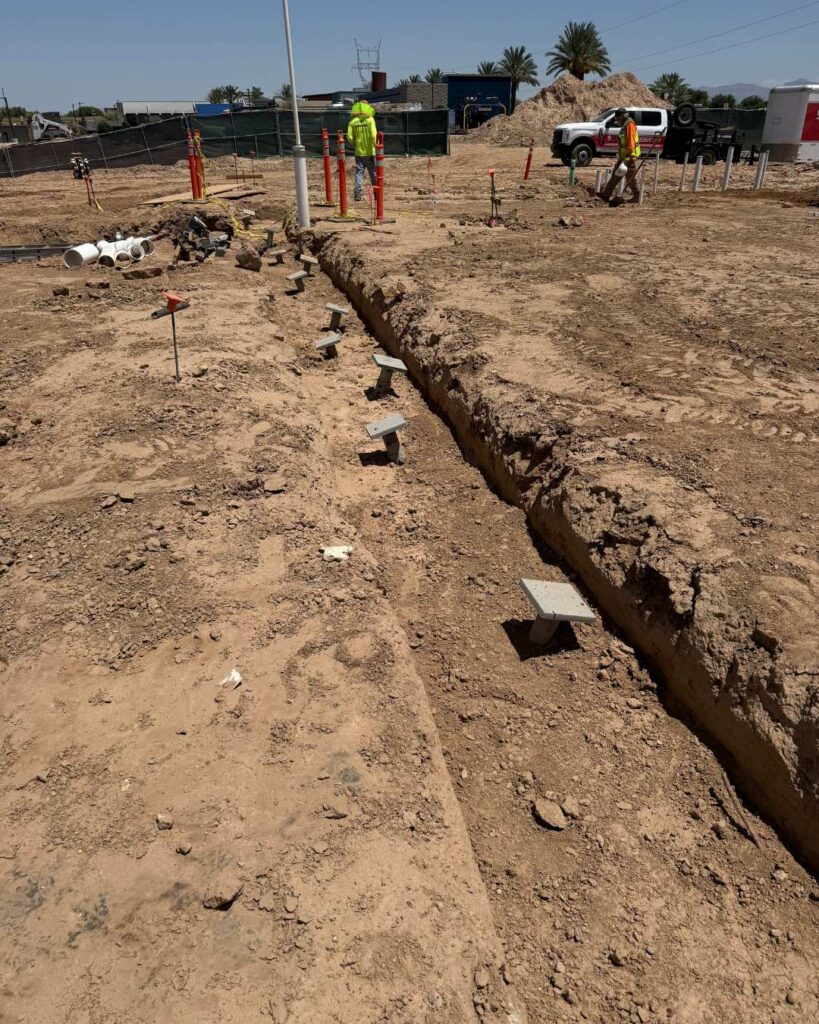
For this project, Straight Line Construction installed all foundation wall piers with a slight batter to resist the required 1.8-kip lateral load. However, the piers supporting interior column footings remained vertical because those locations primarily carried gravity loads. This combination created an efficient foundation system tailored to the building’s structural demands.
By using battered helical piers, the team eliminated the need for approximately 10-foot guide sleeves and threaded extensions. Consequently, the revised design reduced material requirements, simplified installation, and lowered overall project costs while meeting the engineer’s performance criteria.
Commercial Helical Pier Installation
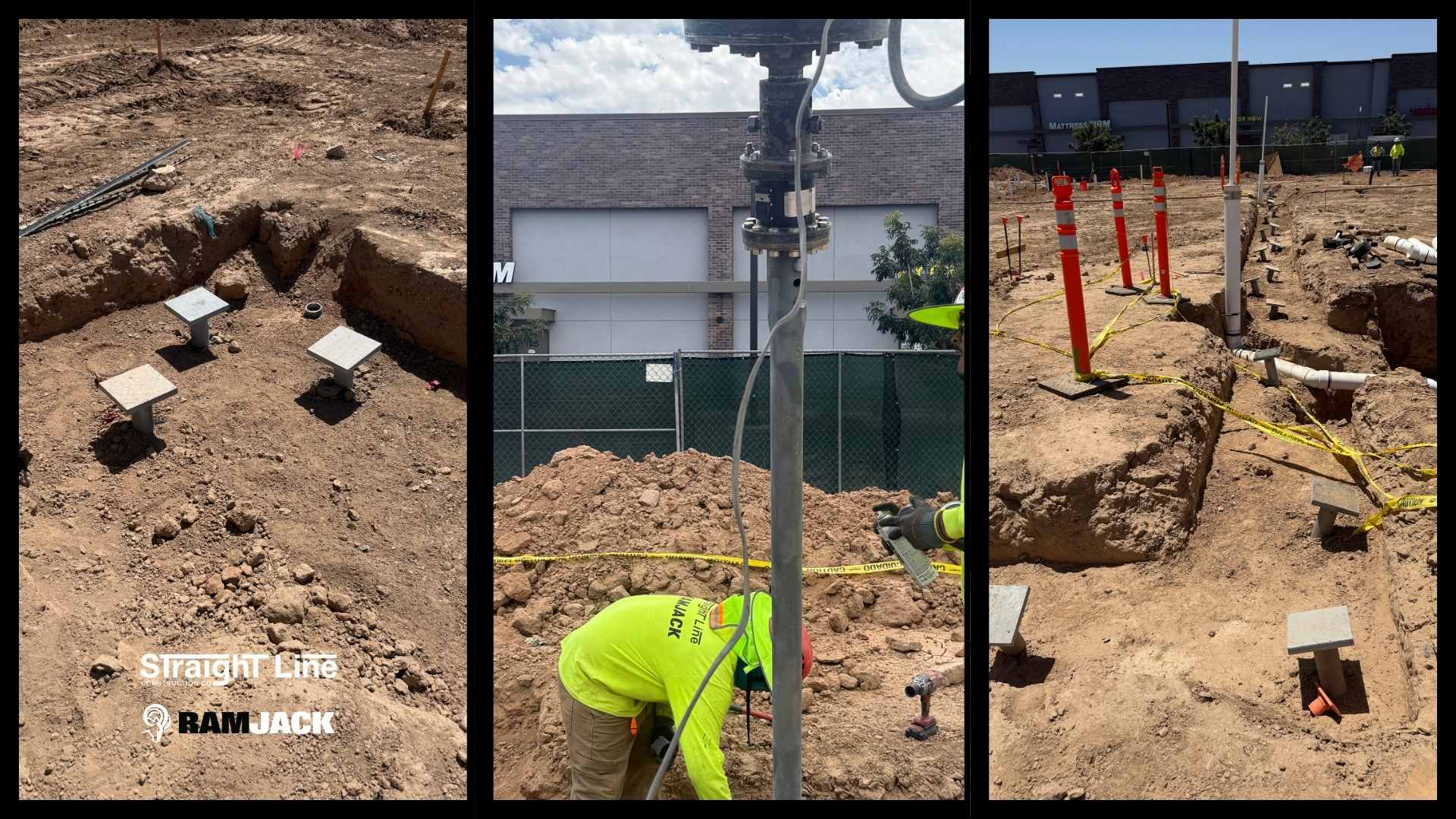
Straight Line Construction installed 85 new construction Ram Jack helical piers to support the new commercial structure. Each pier was designed for a 36-kip allowable capacity using 3.5-inch diameter shafts with 10-inch and 12-inch helix configurations. New construction 9-inch × 9-inch flat plate brackets transferred structural loads directly into the deep foundation system.
Installation depths ranged from approximately 17 to 30 feet, depending on subsurface conditions encountered during construction. To optimize performance, the foundation utilized both battered and vertical installations.
Project Highlights
- 85 new construction Ram Jack helical piers
- 67 battered helical piers
- 18 vertical helical piers
- 36-kip allowable design capacity per pier
- Installation depths ranging from approximately 17 to 30 feet
- 3.5-inch diameter shafts
- 10-inch and 12-inch helix configuration
- 9-inch × 9-inch flat plate new construction brackets
- Galvanized finish for long-term corrosion protection
Installation Challenges and Corrosion Protection
The project geotechnical report classified the native soils as severely corrosive to ferrous metals. Consequently, all Ram Jack helical piers were supplied with a galvanized finish to improve corrosion resistance and provide long-term durability beneath the structure.
Crews installed the piers using hydraulic drive equipment mounted to skid steers, allowing efficient installation on an active construction site. During construction, the team encountered unexpected cobble layers, rocky soils, high summer temperatures, and ongoing coordination with multiple trades. Despite these challenges, Straight Line Construction maintained quality installation standards while supporting the overall project schedule.
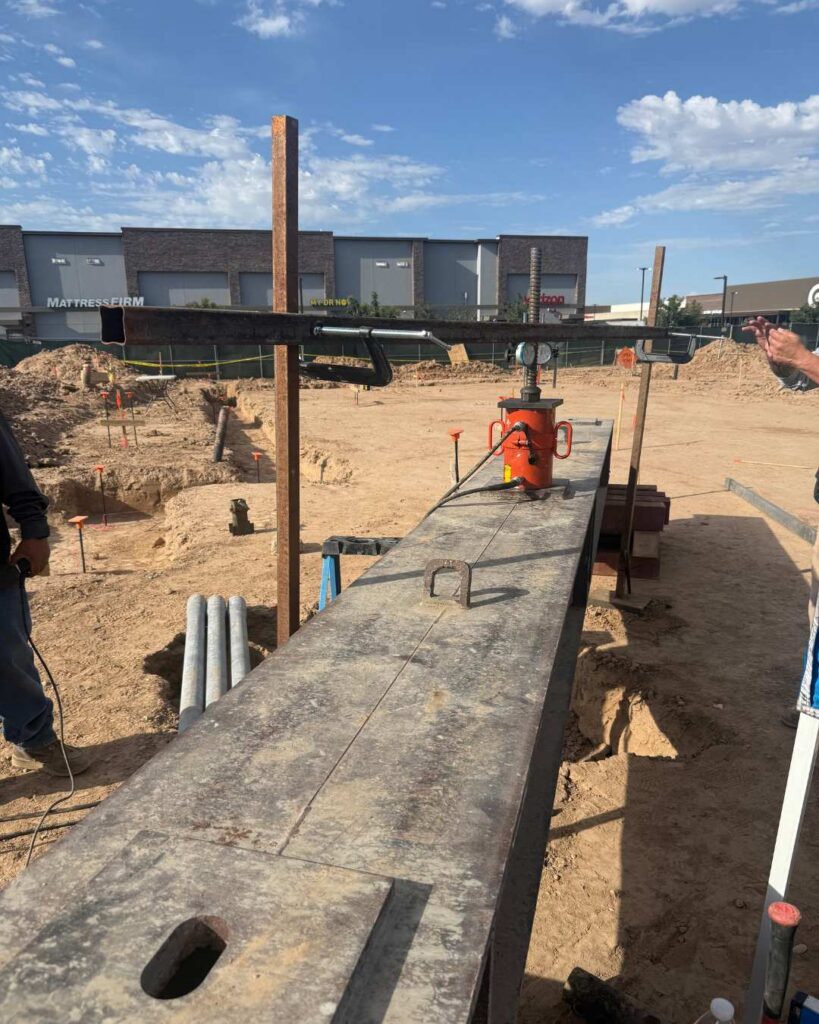
Before production installation began, Ram Jack Arizona performed a verification load test on a sacrificial pier. The test confirmed the foundation design while indicating that a higher installation torque was required to achieve the specified design capacity. Production installation then proceeded using the revised torque criteria.
Engineered Deep Foundation Solutions for Commercial Construction
This project demonstrates Straight Line Construction’s ability to provide more than installation services. By evaluating the project’s structural demands and recommending an alternative battered helical pier design, the team delivered a foundation system that improved constructability, reduced costs, and satisfied demanding lateral load requirements.
From value engineering through final installation, Straight Line Construction continues to partner with engineers, architects, and commercial contractors throughout Arizona to deliver efficient, code-compliant deep foundation solutions for challenging new construction projects.
Helical Pier Design & Installation FAQs
Battered helical piers are installed at a controlled angle rather than vertically. This configuration increases lateral resistance while also supporting vertical structural loads, making them an effective solution for commercial foundations subjected to higher horizontal forces.
Engineers may specify battered helical piers when a structure requires greater lateral resistance than a conventional vertical pier system can economically provide. In many cases, battered piers reduce or eliminate the need for long guide sleeves while maintaining the required design capacity.
Galvanized helical piers provide additional corrosion protection when geotechnical reports identify aggressive or severely corrosive soils. This added protection helps improve the long-term durability and service life of the deep foundation system.
Engineers may require a verification load test before production installation begins to validate the load capacity. Testing often takes the load to twice the design maximums which confirms the helical pier system can more than achieve the specified design capacity under actual field conditions.