Overview: Cabin Foundation Repair in Payson, Arizona
A 1979 wood-framed cabin near Payson, Arizona developed significant foundation damage after years of settlement and moisture exposure. The structure sat on a mix of shallow supports and a crawl space, typical of older mountain cabins in this part of Rim Country.
Over time, weak surface soils, poor drainage, and deteriorated crawl space supports caused differential settlement along multiple sides of the cabin. Rotted beams, shifting supports, and compressible soils created an active structural failure that could not be solved with a single repair method.
To permanently stabilize the structure, the repair required a multi-step engineered solution. The project combined deep foundation support using helical piers, controlled structural lifting to recover lost elevation, crawl space excavation and grading correction to address moisture issues, new concrete pads and adjustable steel posts, and reinforced LVL beam installation to restore proper load paths. By integrating deep soil stabilization with structural framing upgrades, the team delivered a comprehensive, long-term repair rather than a temporary patch.
Settlement signs and failure
Foundation movement was most pronounced along the southwest, west, and northwest sides of the cabin. In these areas, differential settlement caused visible distress. Doors and interior openings racked out of the square, and exterior cracks widened over time. Portions of the floor system felt soft and out of level when walking on.
During a structural assessment, inspectors discovered a rotted beam and unstable crawl space supports. Several supports had shifted, crushed, or lost contact with the framing they were meant to carry. These conditions created an active structural failure that required immediate stabilization. Prompt action helped prevent further damage and restored reliable load paths through the structure.
Subsurface conditions and soil issues
When crews opened the crawl space and excavated around the rear wall, they found soil contacting floor joists and low framing. This improper grading and inadequate clearance trapped moisture against the wood. It also violated building code and created ideal conditions for rot, mold, and termite activity.
Engineers also confirmed that near‑surface soils beneath portions of the cabin were weak and compressible, especially when wet. These soils could not adequately support the cabin’s long‑term loads. As a result, the cabin experienced settlement, sagging beams, and shifting supports. For a reliable repair, the design needed to bypass these weak soils and reach deeper, more stable bearing.
Why helical piers were selected
The engineering team selected helical piers as the primary foundation repair method. This choice matched the combination of poor surface soils, ongoing moisture issues, and the need for controlled structural lifting. Helical piers, also called helical piles or screw piles, use steel shafts with helical plates. Installers twist these shafts into the ground until they reach competent bearing strata.
By installing helical piers below the active zone of seasonal moisture changes and weak soils, crews could transfer cabin loads into stronger layers. This system allows teams to stabilize and lift existing structures with minimal excavation and limited vibration. It also reduces disruption compared to full demolition and reconstruction, which is crucial in established mountain communities near Payson.
Installation and reinforcement scope
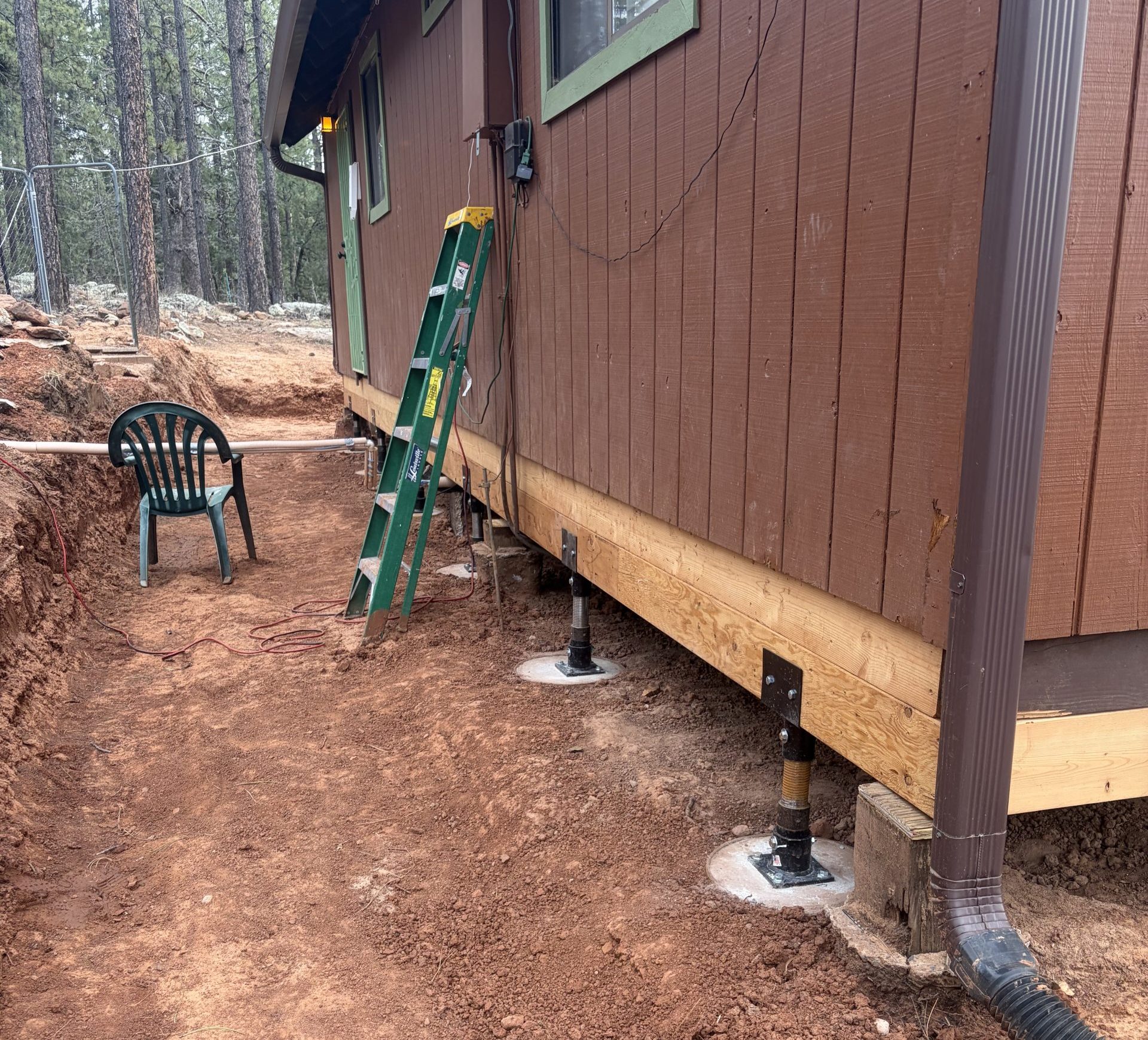
Ram Jack Arizona served as the foundation repair contractor. The team installed the helical piers and completed structural upgrades in the crawl space. Working from the engineered repair plan, the crew installed eighteen helical piers along the affected perimeter and interior support lines.
They installed Ram Jack helical piers with a 2 ⅞ ‑inch diameter shaft to meet design performance. Each pier reached torque ratings of 14,000 ft‑lbs and provided an allowable capacity of 49 kips with a safety factor of two.
Once the piers reached design depth and torque, the team carefully lifted one end of the cabin about two inches. This lift helped recover lost elevation and relevel the floor system as much as practical. Controlled lifting reduced stress on the framing and finishes while improving door operation, wall alignment, and overall cabin performance.
Grading correction and crawl space work
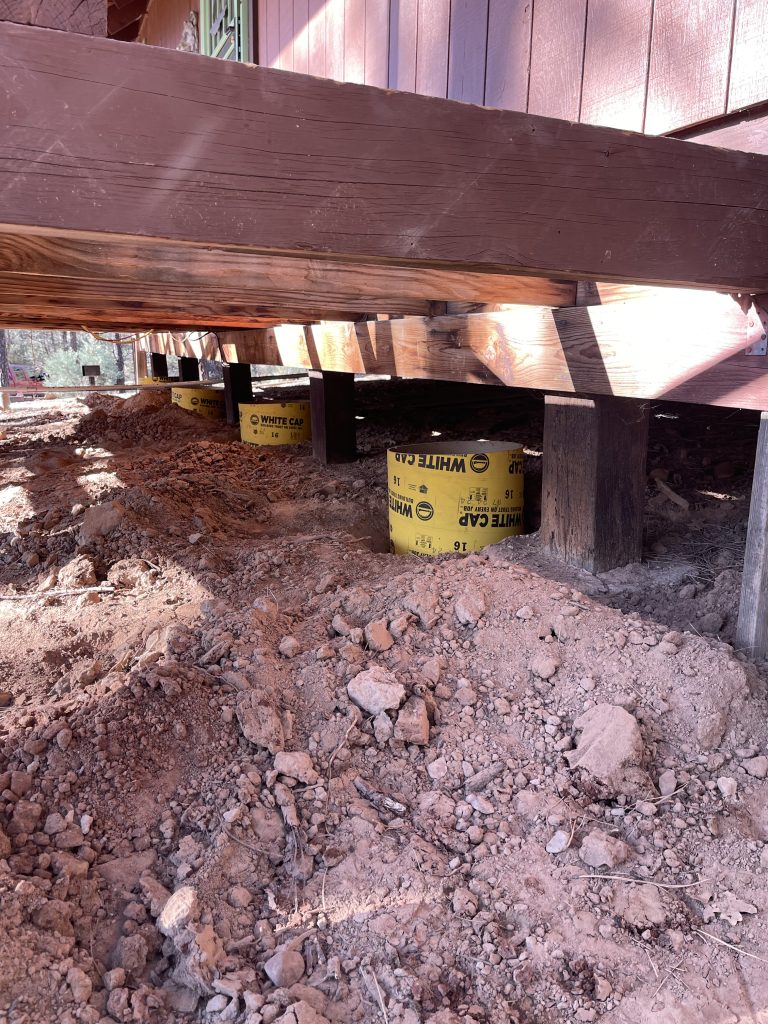
To address moisture and code issues, crews excavated about 16.68 cubic yards of soil from the crawl space and rear wall. Lowering the soil level improved drainage away from the cabin and increased air space beneath the framing. It also removed direct soil contact with floor joists and beams.
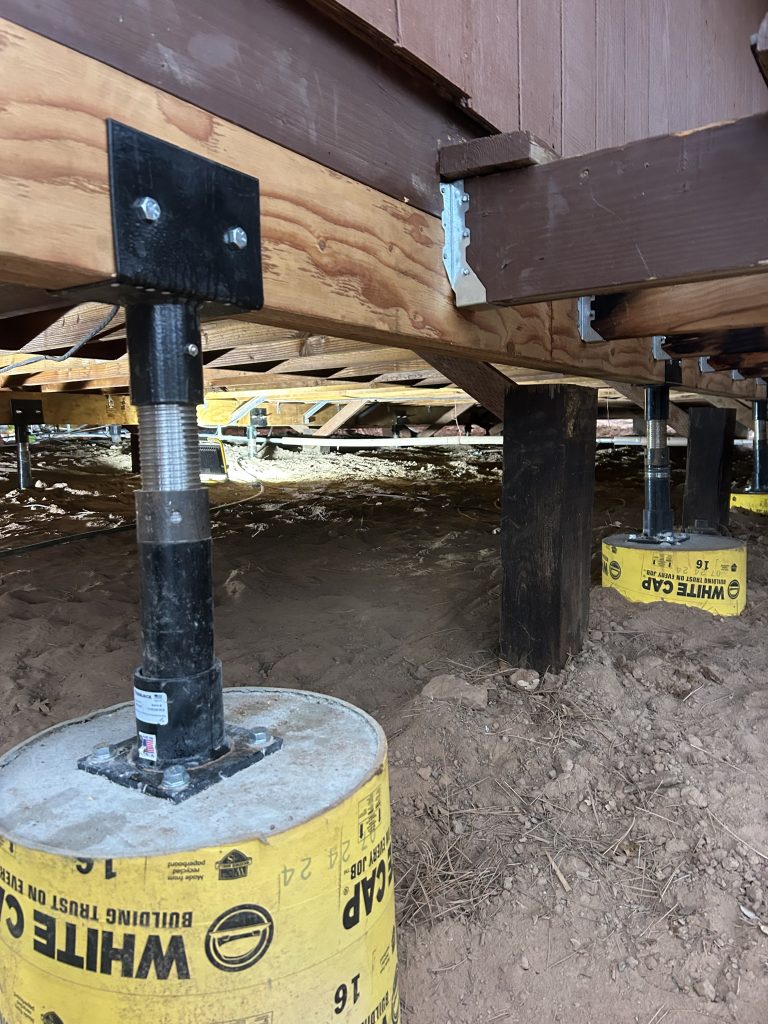
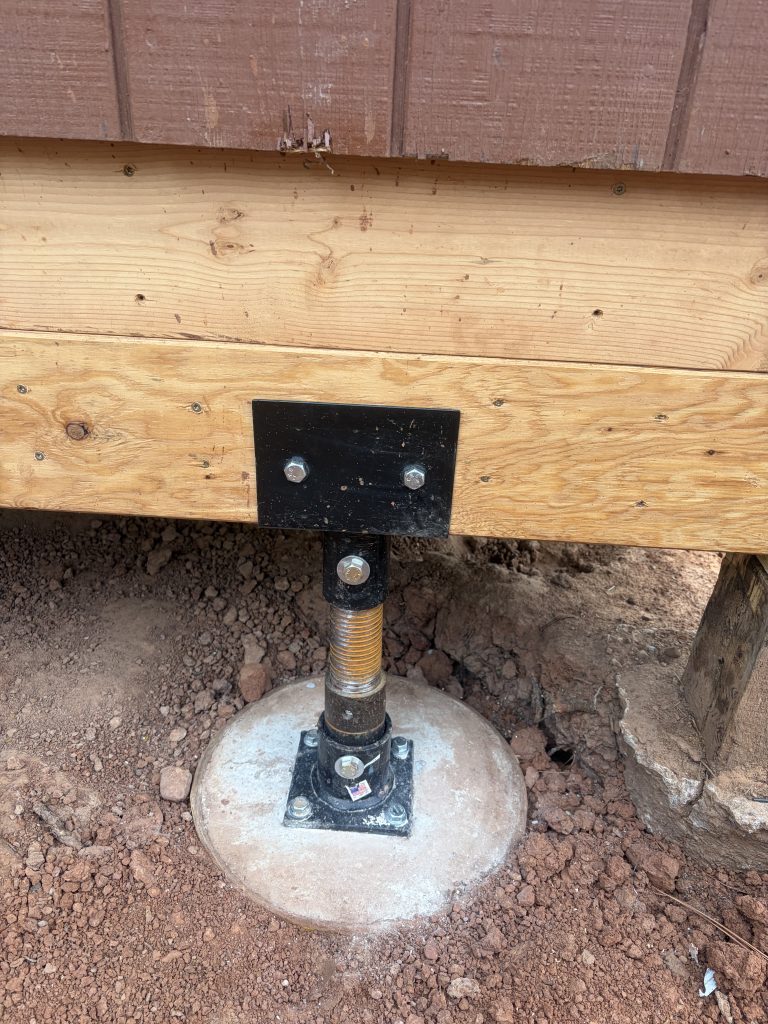
In conjunction with helical pier installation, the team poured fourteen new concrete pads at strategic locations under the cabin. These pads provided stable, level bearing surfaces for new adjustable steel posts. Crews then installed these posts to support new LVL beams and reinforce the existing floor system.
Key structural upgrades
The repair plan combined deep foundation elements with new framing support to create a comprehensive stabilization system. Major upgrades included:
- Eighteen helical piers installed to support perimeter and critical interior load points.
- Fourteen concrete pads constructed in the crawl space for new posts and beams.
- A triple‑reinforced center beam using LVL members to strengthen the main span.
- Adjustable steel posts installed to support the new LVL beam and allow fine‑tuning of elevations and future adjustment if needed.
- The cabin lifted approximately two inches on the affected end to improve level and alignment.
Together, these improvements restored proper load transfer from the cabin into the underlying soils. They also reduced the risk of future movement.
Engineered results and long‑term stability
With the helical pier system in place, structural loads now transfer through weak surface soils into deeper, stronger layers. These layers are less affected by moisture changes and seasonal conditions, which improves long‑term foundation performance. This approach also reduces the likelihood of recurring settlement.
Post‑installation review confirmed that the cabin’s alignment improved and doors operated more smoothly. Floor slopes decreased and created a more comfortable interior. By lowering soil levels by nearly one foot in critical areas, crews improved ventilation around the framing and reduced moisture exposure. This work also helped protect wood components from future rot and insect damage and extended the life of the structure.
Engineered to Exceed Industry Standards
Ram Jack exceeds all engineering standards and product specifications. These standards provide predictable capacity and performance for residential and commercial projects. Straight Line Construction and Ram Jack have stabilized foundations across Arizona for decades. Their experience includes mountains, high‑moisture, and expansive soil conditions.
This Payson cabin project shows how engineered helical piers and targeted structural upgrades can resolve complex settlement issues efficiently. Owners gain a permanent solution rather than a temporary patch such as shimming or stacking non‑engineered supports.
Expert solutions in Payson
Foundation damage in Payson and surrounding Rim Country communities often comes from expansive soils, poor drainage, aging structural systems, and deep seasonal moisture changes. In mountainous areas, precipitation can create a zone of wetting that penetrates up to 12 feet into the ground, weakening soils and undermining foundations over time. Addressing these issues requires engineered solutions that consider local soil conditions, moisture, and the specific structure, because quick fixes that ignore the root cause rarely last.
If you notice cracks, sticking doors, sloping floors, or soft spots in your Payson cabin or home, schedule a professional evaluation. Choose a team experienced in helical pier installation and crawl space repairs. Straight Line Construction and Ram Jack can design a tailored repair plan that stabilizes your foundation, improves safety, and protects the long-term value of your property.
FAQ: Foundation Damage and Helical Piers in Payson
In and around Payson, foundation damage commonly results from expansive clay soils, poor drainage, and long‑term moisture intrusion under cabins and homes. Over time, these conditions weaken support beams and shallow footings, leading to settlement and structural movement.
Helical piers are driven or screwed into the ground until they reach strong bearing layers, then attached to the structure to carry loads. By transferring weight to deeper, competent soils, they bypass weak surface soils and stabilize the foundation, often allowing controlled lifting back toward original elevation.
Yes. In many cases, a settling cabin can be lifted to maximum practical recovery using helical piers installed by the team at Ram Jack Arizona. The achievable lift depends on factors like structural condition, duration of settlement, and existing damage. When properly engineered and installed, these systems allow for controlled lifting that can significantly improve levelness, stability, and structural performance.